Technical
How to Choose a Solar Battery: Capacity, Power and Inverter Compatibility
Learn how to choose a solar battery: load lists, usable energy sizing, power capability, 48V vs 51.2V compatibility, charging and installation checks - with CALLSUN 10.24kWh and 14.34kWh wall-mounted LiFePO4 examples.
Choosing a solar battery involves more than comparing kilowatt-hours. A battery may store enough energy for an overnight backup period yet be unable to support the appliances running at the same time. It may also have the right nominal voltage but require different charging settings or a communication protocol that the inverter does not support.
For installers, distributors and project buyers, a practical selection process starts with the loads, then checks storage capacity, discharge capability, inverter compatibility, charging capacity and installation conditions.
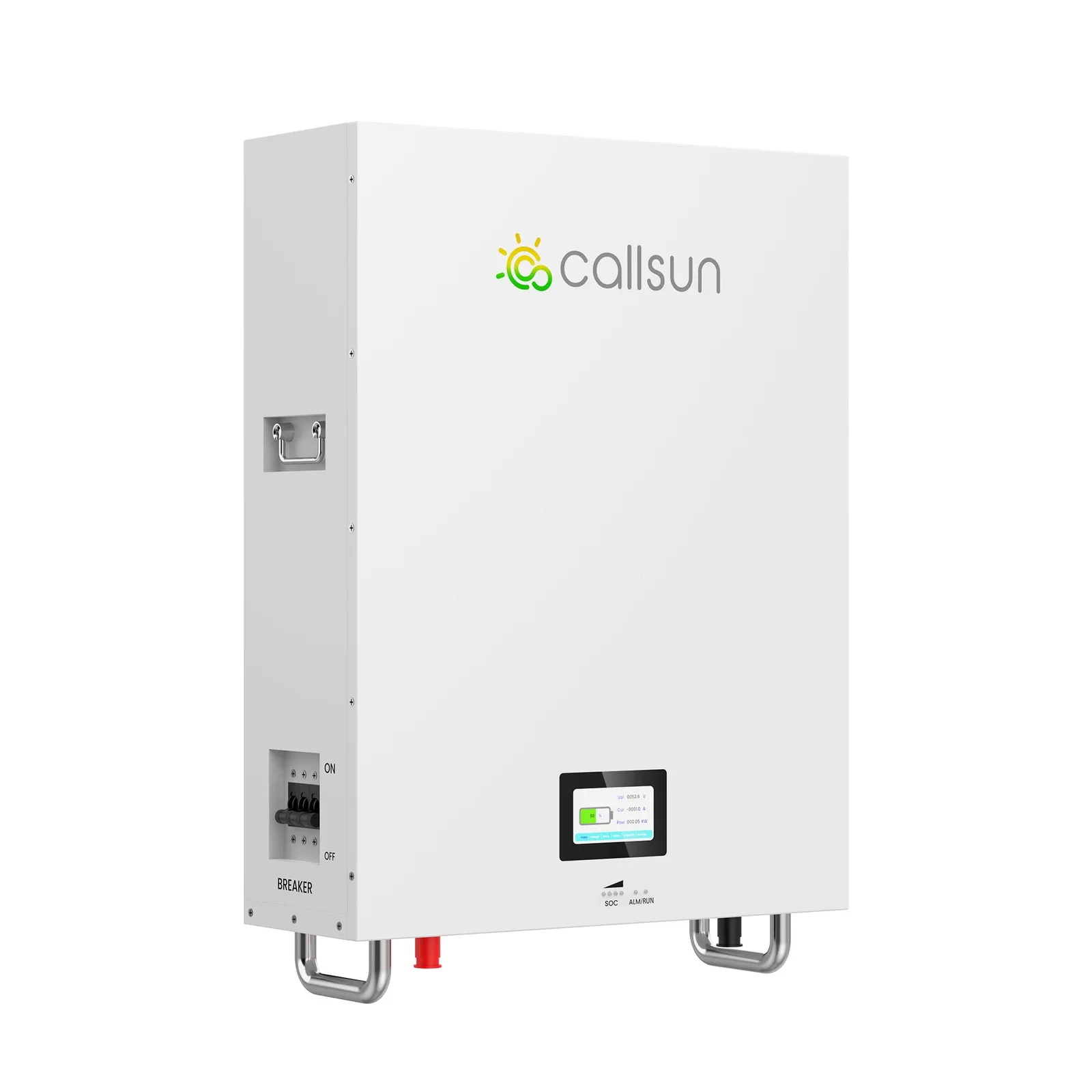
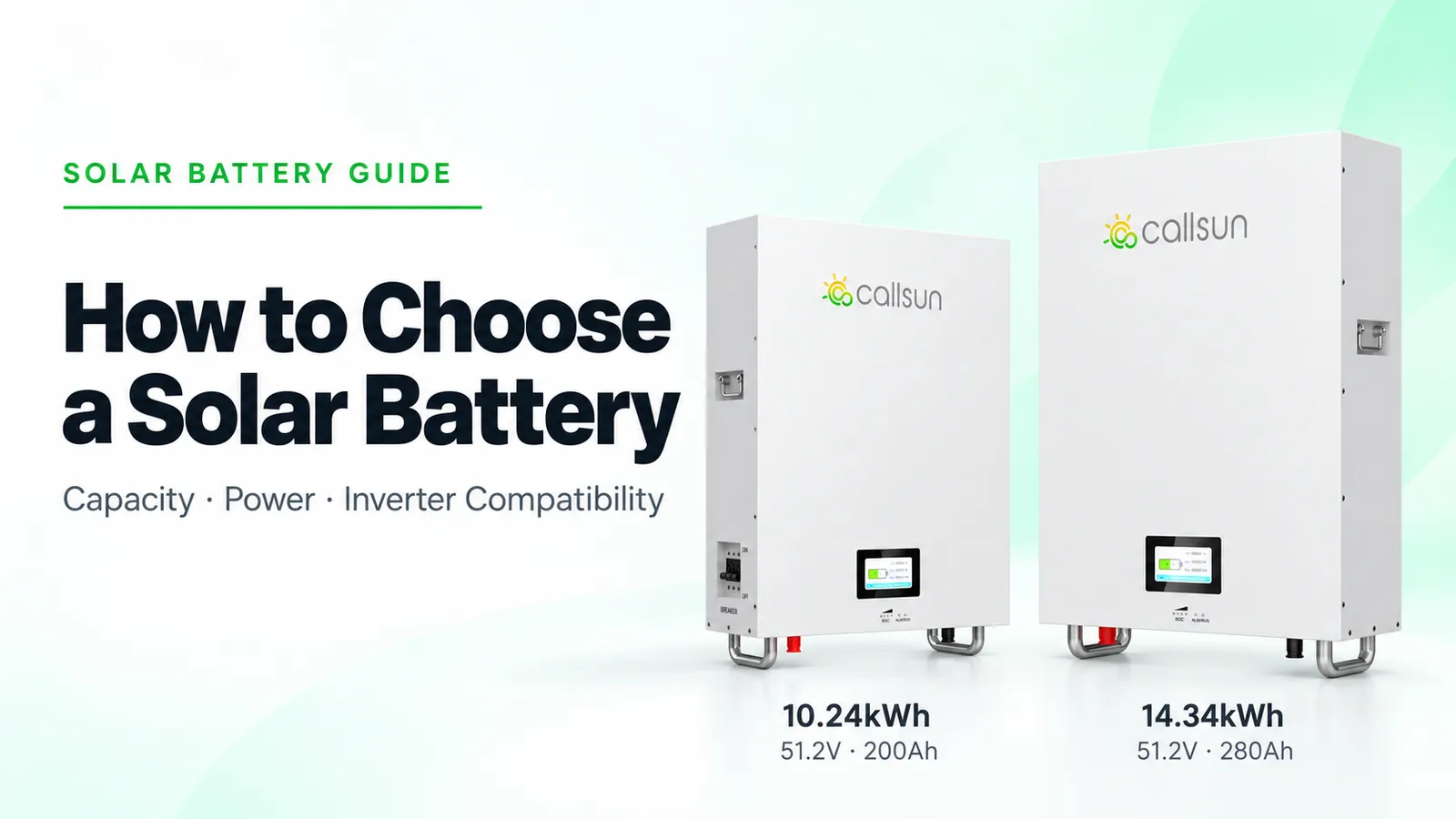
This guide explains those checks using CALLSUN’s 10.24kWh and 14.34kWh wall-mounted LiFePO4 batteries as product examples.
Define the Loads and Backup Duration
Start by identifying which appliances or circuits must remain powered. Essential-load backup and whole-home backup can produce very different battery requirements.
Record three things:
-
The power drawn by each load while operating.
-
How long each load is expected to run.
-
Which loads may operate simultaneously, including equipment with starting surges.
The following example illustrates an eight-hour backup period. The figures are assumptions, not measured appliance specifications.
| Load | Assumed Power | Operating Time | Estimated Energy |
|---|---|---|---|
| Lighting | 100W | 8 hours | 0.80kWh |
| Refrigerator, assumed average over the period | 120W | 8 hours | 0.96kWh |
| Router and communications | 30W | 8 hours | 0.24kWh |
| Computer and display | 150W | 4 hours | 0.60kWh |
| Fans | 100W | 8 hours | 0.80kWh |
| Total | — | — | 3.40kWh |
This table estimates energy consumption. It does not establish the required inverter rating or starting capability.
A refrigerator compressor, pump or air conditioner may briefly demand substantially more power when starting. Check the equipment specifications or measure the load before selecting the battery and inverter.
Size the Battery Using Usable Energy
Battery capacity is usually stated as nominal energy in kilowatt-hours. The energy delivered to AC appliances will be lower after accounting for the operating state-of-charge window and conversion losses.
A simplified sizing equation is:
Required nominal battery energy = Load energy ÷ (usable capacity fraction × inverter efficiency)
For illustration, assume:
-
The backup loads require 8kWh.
-
The planned operating window makes 90% of nominal battery energy available.
-
Inverter efficiency is assumed to be 92%.
The estimated nominal capacity required is:
8kWh ÷ (0.90 × 0.92) ≈ 9.66kWh
These percentages are calculation assumptions, not CALLSUN product performance claims. A project assessment should use the approved battery operating limits, inverter efficiency at the expected load and any additional reserve requirement.
Temperature, battery ageing, standby consumption and variations in appliance use can also affect the result. Where backup continuity matters, allow an appropriate design margin rather than selecting a battery that only just meets the estimate.
How long does a 10kWh battery last?
Runtime depends on average load and usable energy.
Using the same illustrative assumptions, a 10.24kWh battery would provide approximately:
10.24 × 0.90 × 0.92 ≈ 8.48kWh at AC loads
At a constant 1kW load, that represents approximately 8.5 hours. At a constant 2kW load, it represents approximately 4.2 hours.
These are simplified estimates. They do not guarantee runtime or confirm that a particular load is within the battery and inverter’s output limits.
Check Power Capability Separately from Capacity
Kilowatt-hours describe stored energy. Kilowatts describe power delivered at a particular moment.
This distinction becomes important when comparing batteries with different capacities.
CALLSUN’s current product specifications list:
| Specification | 10.24kWh Model | 14.34kWh Model |
|---|---|---|
| Nominal voltage | 51.2V | 51.2V |
| Rated capacity | 200Ah | 280Ah |
| Nominal energy | 10.24kWh | 14.34kWh |
| Maximum discharge current | 150A | 150A |
| Maximum charge current | 100A | 150A |
The 14.34kWh model provides approximately 40% more nominal stored energy. Both models list the same maximum discharge current.
The larger model therefore offers more storage, but its higher capacity alone does not establish a higher output-power rating.
A useful electrical relationship is:
DC power = Battery voltage × Battery current
At 51.2V and 150A, the arithmetic result is 7.68kW of DC power. This is not a guaranteed continuous output rating or an AC system rating. Actual capability depends on operating voltage, permitted current duration, temperature, BMS limits, wiring and inverter efficiency.
Before approving a system, confirm:
-
Permitted continuous battery discharge current.
-
Any peak-current allowance and its duration.
-
Inverter continuous and surge ratings.
-
Battery-side cabling and protection requirements.
-
Whether the complete system can support the intended starting loads.
A larger inverter cannot draw unlimited power from a battery. The battery and inverter must both support the load.
Verify Inverter Compatibility Beyond the “48V” Label
Buyers frequently use “48V solar battery” when searching for low-voltage storage. CALLSUN’s two batteries have a nominal voltage of 51.2V.
A shared voltage category is a starting point for selection. Compatibility still requires several checks.
Battery operating voltage
Compare the battery’s permitted operating range with the inverter’s supported battery range. Check charging targets, discharge cut-off settings and any manufacturer-required configuration.
Charging and discharging current
Inverter settings must respect the battery’s approved limits. Where multiple charging sources operate together, their combined contribution must remain within the permitted system limits.
BMS communication
A matching connector or the presence of CAN or RS485 does not, by itself, establish compatibility. The devices must support the appropriate communication protocol and configuration.
Verify the inverter model, firmware, cable pinout and battery settings using the relevant manufacturer documentation.
System architecture
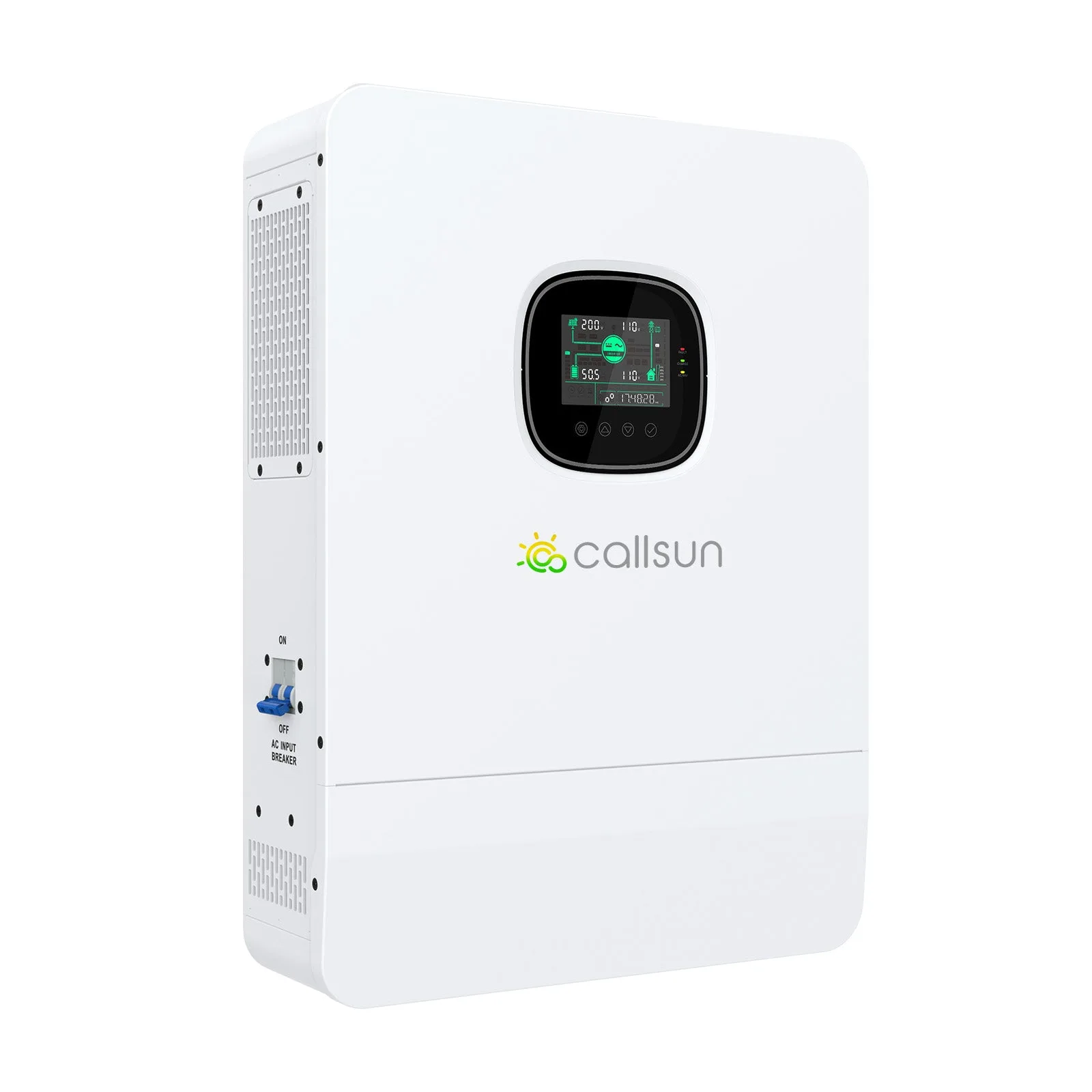
Confirm whether the project uses a compatible low-voltage hybrid inverter, a separate inverter-charger or another supported architecture.
A 51.2V battery should not be assumed suitable for equipment designed around a high-voltage battery platform.
For project review, provide the exact inverter model and firmware version rather than only the inverter brand.
Explore CALLSUN Hybrid Inverters
Check Whether the System Can Recharge the Battery
A battery must be large enough to serve the loads, and the charging system must be able to replenish the energy used.
For solar charging, assess:
-
Expected daily solar production at the project location.
-
Seasonal variation and shading.
-
Energy consumed while solar production is available.
-
The inverter or charge controller’s charging limits.
-
Battery charging limits and operating temperature.
-
Any grid or generator charging arrangements.
A larger battery can increase storage capacity without increasing daily solar production.
For example, if the system can deliver only 6kWh per day to the battery after daytime consumption and losses, increasing storage capacity will not create additional charging energy. Repeatedly using more than that amount will progressively reduce the available reserve unless another charging source contributes.
CALLSUN’s current specifications list a maximum charge current of 100A for the 10.24kWh model and 150A for the 14.34kWh model. These figures do not establish actual charging speed. The available source, charger settings, battery state of charge and operating conditions also matter.
Include Installation Conditions in Product Selection
Physical and environmental requirements can determine whether a battery is suitable for a site.
| Installation Parameter | 10.24kWh Model | 14.34kWh Model |
|---|---|---|
| Dimensions | 720 × 550 × 200mm | 900 × 675 × 200mm |
| Weight | 102.5kg | 128.5kg |
| Enclosure protection | IP20 | IP20 |
| Charging temperature | 0–55°C | 0–55°C |
| Discharging temperature | −20–55°C | −20–55°C |
For these IP20 models, plan an appropriate dry, protected indoor location in accordance with the installation documentation.
Wall mounting also requires assessment of the supporting structure, mounting hardware, handling method, service access and required clearances. The battery’s weight makes these practical checks important before delivery.
Charging and discharging temperature ranges are different. Operation at a low discharge temperature does not imply that charging is permitted at the same temperature.
Confirm installation requirements with the product documentation and applicable local requirements before approving the site.
Compare 10.24kWh and 14.34kWh Against the Same Project Requirements
The appropriate model depends on the energy requirement and the complete system design.
The 10.24kWh model may be a candidate where the calculated backup-energy requirement fits within its available usable energy, with adequate reserve, and the load remains within the approved system limits.
The 14.34kWh model may be a candidate where the project requires more stored energy for longer backup duration or greater consumption between charging periods.
Evaluate both models using the same load profile, operating assumptions and installation requirements. Do not select solely by house size or assume that the larger battery supports higher-power appliances.
If expansion is required, confirm approved parallel configurations, communication arrangements and installation requirements before including additional batteries in the design.
View the CALLSUN 10.24kWh Wall-Mounted Battery
View the CALLSUN 14.34kWh Wall-Mounted Battery
Prepare the Information Needed for a Useful Quotation
A clear inquiry helps suppliers recommend an appropriate configuration and reduces unnecessary quotation revisions.
For a battery or system inquiry, provide:
-
Project country and delivery destination.
-
Application: home backup, off-grid operation or another defined use.
-
Load list, simultaneous running power and starting-load requirements.
-
Target backup duration and estimated energy consumption.
-
Inverter model, firmware and existing battery configuration.
-
Solar array details and available charging sources.
-
Installation environment and space constraints.
-
Order quantity, delivery schedule and required documentation.
Distributors should also confirm model-specific certification evidence, warranty terms, technical support and the process for handling faults or replacements in the destination market.
CALLSUN offers 10.24kWh and 14.34kWh wall-mounted LiFePO4 batteries with a nominal voltage of 51.2V. You can compare CALLSUN solar batteries, review hybrid inverter options, or browse reference solar-plus-storage configurations for system-level planning.
Tagged
Next step
Discuss Your Solar Battery Requirements with CALLSUN
Share your loads, backup target, inverter model, installation conditions and order quantity. Our team can review the requirements and provide relevant product specifications, system matching information and B2B pricing.
Request a Battery QuoteContinue Reading