Industry
Buying Solar Panels by the Pallet vs. Smaller Quantities: How to Choose
Pallet pricing lowers the per-module quote but not always the cost of the purchase. Compare demand, cash, storage, resale and timing before choosing pallet or smaller quantities.
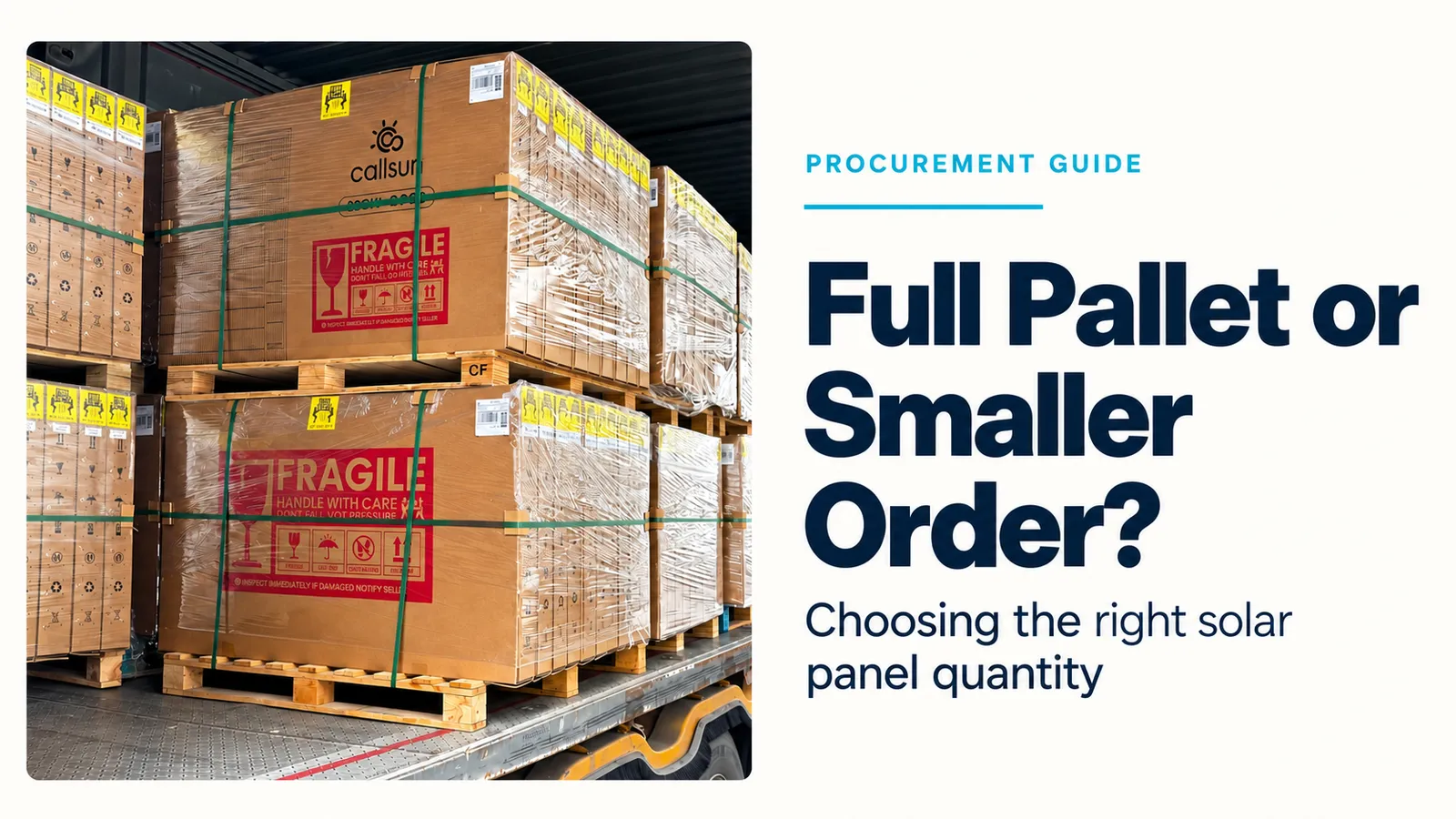
Buying solar panels by the pallet can lower the quoted price per module. Whether it lowers the cost of the purchase depends on how many panels the buyer can use, how the shipment will be handled, and what happens to any remaining stock.
For an installer, the question is whether the order fits confirmed projects. For a local dealer, it is whether the modules fit established customer demand. Both may purchase the same pallet, but they are making different inventory decisions.
A useful starting point is to separate the panels needed now, the panels assigned to upcoming work, and the panels being purchased without a confirmed use. That distinction often matters more than the advertised quantity discount.
Pallet quantities vary by module and packaging configuration. Buyers should confirm the exact model, panel count, dimensions, and shipment weight rather than assuming that every pallet contains the same amount of equipment.
The Callsun CS450W datasheet specifies 36 modules per pallet. At 450W each, this represents 16.2kW of rated module capacity. A requirement for 24 modules would use 10.8kW of that capacity and leave 12 modules in inventory.
These figures describe the quantity being purchased. They do not establish whether the modules fit a particular roof, ground mount, inverter, or controller. Electrical and mechanical suitability should be confirmed before deciding how many to order.
The relevant comparison is between the total cost of buying the required quantity and the total cost of buying a pallet.
Consider a hypothetical project requiring 30 panels. A smaller-quantity quotation is $150 per panel, with $300 freight, making the purchase total $4,800. A 36-panel pallet is offered at $135 per panel, with $450 freight, making the total $5,310. These are illustrative figures, not actual supplier quotations, and exclude taxes and other charges.
The pallet has a lower delivered cost per panel: $147.50 compared with $160. Yet it requires $510 more cash upfront and leaves six panels.
That additional $510 buys six modules beyond the current requirement. If those modules are suitable for confirmed future work, the pallet may be attractive. If they have no identified use, the buyer has paid more to complete the present project and taken on inventory.
A lower unit cost and a lower immediate cash requirement are different outcomes. The buyer needs to decide which matters for the order.
An installer may be able to use a pallet across several jobs. That can make the purchase more efficient, provided the same module is suitable for each project and the schedules are sufficiently firm.
Two projects requiring 18 panels each appear to match a 36-panel pallet exactly. Before combining the purchase, however, the installer needs to confirm dimensions, electrical characteristics, mounting requirements, applicable documentation, and customer specifications for both jobs.
A shared power rating is not enough. Two projects may need different module formats or electrical configurations even when their total capacity is similar.
Timing also affects the decision. A signed project with an agreed installation schedule provides a stronger basis for purchasing than an open quotation. If the second job is delayed or cancelled, the installer retains the stock and its associated cash commitment.
Combining orders works best when it consolidates compatible, reasonably certain demand. Otherwise, the apparent purchasing efficiency depends on work that may not materialize.
Local dealers and pallet-breakdown sellers purchase in bulk to serve customers who need smaller quantities. Their value includes holding stock, offering convenient collection, preparing individual orders, and helping customers identify suitable products.
A pallet discount supports that business, but it does not establish the margin.
The selling price must cover delivered purchase cost and the work of selling smaller lots. Handling, storage, payment fees, customer communication, damage, and after-sales support all affect the result. Unsold stock also holds cash that could have been used elsewhere.
An established dealer can assess the order against recent sales: which wattages and dimensions customers request, typical order sizes, and how frequently inventory moves. A new reseller has less evidence and should be cautious about treating an attractive purchase price as proof of demand.
The most useful question is not simply, “How much can I mark up each panel?” It is, “Can I sell this specific model through the customers and delivery arrangements I already have?”
Extra modules may have a legitimate purpose. They can be allocated to upcoming installations, held as compatible replacement stock, or sold through an existing channel. Each purpose needs its own justification.
Replacement stock is useful only if the model and storage arrangements support the intended need. Future-project stock is useful only if those projects can use it. Resale stock needs a realistic route to customers.
Do not assume that every surplus panel can be sold at the prevailing retail price. A local sale and a shipment to another state have different economics. The cost of delivering one or two modules can substantially change what a prospective buyer is willing to pay.
It is also important to distinguish inventory value from available cash. An unused module remains an asset, but it cannot pay labour, transport, or other project expenses until it is sold or put to use.
A full pallet requires a receiving and storage plan. The buyer needs the packed dimensions and gross weight, appropriate unloading arrangements, and a suitable location for keeping the modules.
The Callsun CS450W datasheet lists individual module dimensions of 1762 × 1134 × 30mm and a weight of 23.97kg. These specifications help assess individual handling requirements, but they do not replace the packed pallet dimensions or shipment weight.
Breaking a pallet also changes how the remaining modules are managed. Loose stock needs suitable support and protection, consistent with the manufacturer’s handling instructions. Model identification and quantity records should remain clear as panels are removed.
For a dealer already equipped to receive and store pallets, this may be routine. For a small installer without storage space, the lower purchase price may come with additional logistics work.
A smaller order can be appropriate when it meets a defined requirement and avoids uncertain surplus. This is particularly relevant for replacements, limited-space installations, or projects using a model that is unlikely to recur.
The buyer should still check the supplier’s minimum quantity, packaging, freight, and any pallet-breakdown charges. A small order with high shipping costs may be difficult to justify; local pickup may offer a different result.
Availability also matters. A supplier selling only full pallets cannot be assumed to support smaller orders, and a dealer selling individual modules may have limited stock. Confirm the purchasing options for the exact model.
Planning a full-pallet purchase? Explore Callsun’s 450W solar panel pallet availability in the USA. The minimum order is one pallet of 36 panels, providing 16.2 kW of rated capacity. Check current stock and request a delivery or warehouse pickup quote.
The decision should compare actual alternatives. “Full pallet versus smaller quantity” has no universal answer without prices, delivery conditions, and a use for the additional panels.
Before committing to a pallet, an installer should be able to identify which modules are assigned to confirmed work, what remains unallocated, and whether the purchase leaves enough cash to finish the installations.
A reseller should be able to explain who buys the model, how smaller orders will be fulfilled, and how long the business can reasonably hold the inventory.
Full-pallet purchasing is most useful when it consolidates suitable demand and spreads delivery costs efficiently. Smaller purchases can be more appropriate when the requirement is narrow or the remaining inventory would be speculative.
For Callsun CS450W procurement planning, the datasheet’s 36-module pallet provides a clear quantity reference. Buyers can share project requirements or expected resale demand for specification and order review. Available quantities, packaging, pricing, and delivery options should be confirmed for the specific order.
Tagged
Next step
Unsure whether a pallet or smaller quantities fit your pipeline?
Share your confirmed projects, resale channels or project requirements - Callsun will help review the quantity, packaging and delivery option that matches your demand and cash plan.
Contact Callsun